For WordPress developers who self-host plugin and theme updates, reliability matters just as much as flexibility. It is not enough to make updates work once. They need to work consistently across multiple products, multiple environments, and increasingly complex plugin stacks.
That is why UUPD 2.0 is such an important release.
At a glance, V2.0 may appear to be an internal refactor. Under the hood, though, it represents a significant step forward in how self-hosted updates are identified, scoped, and managed. The result is a system that is safer to bundle and far better suited to modern plugin development.
Most importantly, it continues UUPD’s core mission: making self-hosted WordPress updates easier, faster, and cheaper than relying on external infrastructure.
Why V2.0 Matters
The biggest change in UUPD 2.0 is also the most important one: identity is no longer based on slug alone.
In earlier versions, the updater effectively treated a plugin or theme as a single slug-based identity. That worked well in many cases, but it also created a hidden risk. If multiple bundled updaters use similar or overlapping names, collisions could occur in filters, cache keys, or update state. The more plugins and themes a developer maintained, the greater the risk grew.
Version 2.0 fixes that at the foundation level.
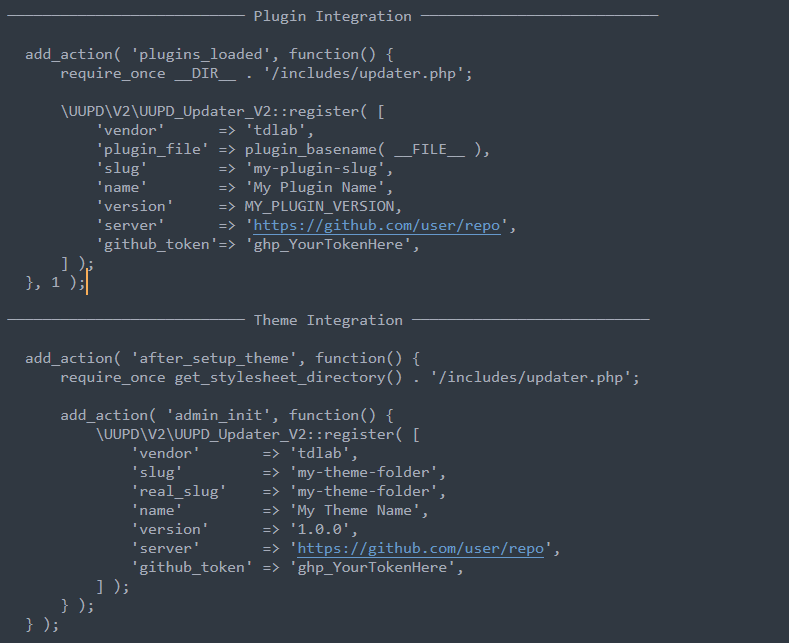
Every updater instance is now identified by:
vendor + slugThat means update registrations are no longer just my-plugin. They become something more like my-company + my-plugin. This is a major improvement because it makes the updater far more reliable in real-world use, especially when the same site is running multiple custom products from different developers or vendors.
This is not just a cosmetic tweak. It is a structural improvement that makes UUPD much more robust for agencies and independent developers who bundle a common updater across several projects.
A More Reliable Identity Model
The new vendor-aware identity system changes several important areas of the updater.
Filters are now scoped using both vendor and slug. Cache keys are derived in a vendor-aware way. Manual update checks are vendor-aware, too. In practice, this means the updater now behaves more like a proper namespaced system instead of a collection of slug-based assumptions.
That matters because self-hosted update systems often fail in subtle ways. They can appear to work during early development, only to run into conflicts later when more products are added, sites become more complex, or two plugins happen to use similar conventions.
By making identity explicit, V2.0 eliminates an entire class of avoidable problems.
Better for Bundled Updaters
One of the best things about UUPD has always been that it can be copied directly into a plugin or theme. There are no external dependencies, no special framework requirements, and no need to force every project into the same architecture.
Version 2.0 makes that bundling story even stronger.
Because the updater now works with vendor-aware identity and can be safely rescoped into a branded namespace and class, developers can ship isolated updater copies inside their own products with much less risk of accidental interaction.
That is a big win if you maintain multiple commercial plugins, white-label products, or client-specific builds. You can bundle the updater once per product, brand it cleanly, and know that each copy is much less likely to interfere with anything else running on the site.
Update Modes Remain Flexible
While V2.0 introduces a stronger internal model, it keeps the flexibility that made previous versions useful.
UUPD still supports two core update approaches:
JSON metadata mode for private or custom update servers, and GitHub Releases mode for projects that publish releases through GitHub.
That means developers can still choose the hosting strategy that works best for them:
A lightweight JSON endpoint for complete control, or GitHub-based releases for a workflow built around tags, assets, and release automation.
The auto-detection system remains in place as well. If the configured server is a GitHub repo root, UUPD can switch into GitHub Releases mode automatically. Otherwise, it behaves as a JSON-driven updater. Developers can also explicitly force a mode when needed.
This balance is one of UUPD’s biggest strengths. It gives developers modern update flexibility without forcing them into a single hosting model.
GitHub and Private Asset Support
Self-hosting updates are only useful if they work in the real world, and that includes private repositories and private release assets.
UUPD 2.0 continues to support GitHub tokens for authenticated requests, which is essential for developers distributing commercial plugins or private builds through GitHub. Release asset selection can also be configured more precisely, making it easier to work with structured release packages.
That means you can continue to use GitHub as an affordable update delivery platform without giving up control over access.
For many developers, that is a practical middle ground: no expensive SaaS dependency, no custom update service to maintain, and no need to reinvent the full release pipeline from scratch.
Smarter Caching, Same Lightweight Approach
Caching has always been one of UUPD’s quiet strengths. It keeps update checks efficient, reduces unnecessary remote requests, and makes the system feel fast inside the WordPress admin.
Version 2.0 keeps that lightweight caching approach, but improves its safety by scoping cache keys in a vendor-aware way. This is another area where the move from slug-only identity to vendor-plus-slug pays off.
The result is simple but important: a more predictable update state, fewer accidental overlaps, and better behaviour when the same site runs multiple products that each bundle the updater.
Optional Branding Still Makes It Feel Native
A self-hosted updater should not feel like a second-class experience. One of the reasons UUPD has been so useful is that it supports branding assets such as icons, banners, and screenshots, helping custom plugins and themes feel right at home in the native WordPress update UI.
That continues in V2.0.
Whether metadata comes from JSON or assets are supplied through config and filters, developers can still shape a polished update experience without depending on WordPress.org.
That matters because self-hosting should not mean sacrificing presentation. Developers should be able to control both delivery and user experience.
Manual Checks and Debugging Stay Practical
The release also keeps practical, developer-friendly touches that make UUPD usable day to day.
Manual “Check for updates” support remains available, which is invaluable when testing release pipelines or validating a new deployment. Debug logging is still easy to enable. Cache lifetimes remain filterable. The updater stays small, understandable, and straightforward to work with.
Those details matter. A self-hosted updater is only truly useful if developers can troubleshoot it quickly and test it confidently.
The Real Value of V2.0
The most important thing about UUPD 2.0 is not that it adds complexity. It is that it removes uncertainty.
Moving to a vendor-aware identity model makes the updater more reliable in the exact scenarios where developers need it most: multiple products, bundled copies, branded builds, client deployments, and long-term maintenance.
That is what makes it a significant improvement rather than just a version bump.
It solves a structural weakness in the old model, strengthens the updater for modern development workflows, and preserves the lightweight, copy-and-ship simplicity that made UUPD useful in the first place.
Making Self-Hosted Updates Easier, Faster, and Cheaper
At the end of the day, that is still the real promise of UUPD.
Self-hosting plugin and theme updates should not require a large platform, an expensive subscription, or a complex release service. It should be possible to deliver updates from infrastructure you already control, using workflows you already understand, while keeping the WordPress experience native and familiar.
UUPD 2.0 moves that goal forward.
It makes self-hosted updates easier by improving clarity and reducing collisions. It makes them faster by keeping the updater lightweight and cache-friendly. And it makes them cheaper by letting developers continue to use simple JSON endpoints, GitHub releases, and bundled code, rather than paying for unnecessary overhead.
For developers who want control without complexity, V2.0 is a meaningful step in the right direction.
Moving Onwards and Upwards.
2.0 – Alpha has been released today and is a significant improvement on what came before it. The push for 2.0 has also allowed me to develop a standalone UI class and a compatibility layer for several common licensing providers. This will be released in due course and will be the next step in using UUPD with your current licencing provider, such as FluentCart, Woo API, WP Software Licenceing, EDD, Get paid and WPHoster.